.png)
Accenture x Teleskope Panel Discussion
Employee Experience and ERG Insights (Full Transcript)
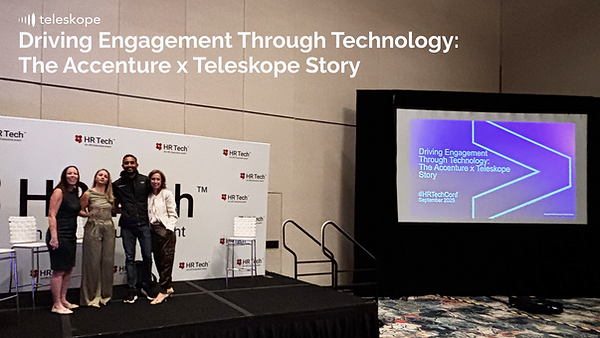
About This Session
Event: HR Tech Conference 2025, Las Vegas
Session Title: Driving Engagement Through Technology: The Accenture x Teleskope Story
Date: September 2025
This panel discussion showcases how Accenture, one of the world's largest professional services companies with 800,000 employees across 49 countries, partnered with Teleskope to solve enterprise-scale employee engagement challenges. The session covers practical implementation details, measurable results, and lessons learned from deploying a unified employee experience platform across North America.
Meet the Panelists
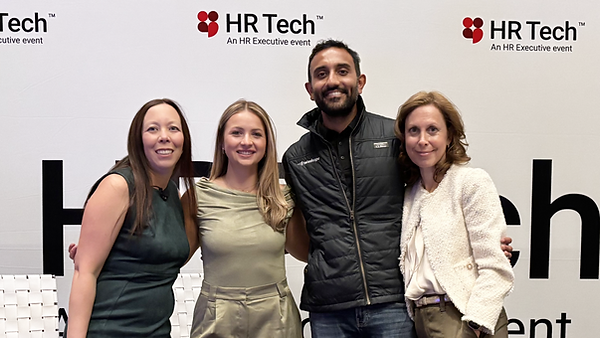
In image from left to right: Tamara Huckle (Accenture), Melody Crane (Accenture), Maneet Sarai (Teleskope) and Felicia Jacobs (Accenture)
Key Themes
-
Centralized Employee Experience Platform: How consolidating fragmented tools (SharePoint, spreadsheets, Outlook) into one platform transforms engagement visibility and participation
-
Data-Driven Event Management: Using real-time analytics to understand attendance patterns, optimize event timing, and prove ROI to leadership
-
ERG Governance at Scale: Implementing structured approval workflows, compliance controls, and standardized processes across global ERG programs
-
Personalized Employee Discovery: Creating curated, personalized event feeds so employees find relevant opportunities without information overload
-
Leadership Engagement: Strategies for getting executives visible and accessible through systematic event participation
-
Hybrid Work Optimization: Understanding when virtual vs. in-person events drive better outcomes and adjusting strategy accordingly
-
Full Employee Lifecycle Coverage: Connecting pre-boarding, mentoring, ERGs, office events, and alumni programs in one continuous journey
Key Outcomes
For Employees
-
Single destination to discover all ERGs, office events, and engagement opportunities
-
Personalized "Get Engaged" page filtering relevant content by interests and affiliations
-
Ability to see what's happening at any office when traveling
-
One-click joining for ERGs and event RSVPs
For ERG Managers
-
Eliminated manual spreadsheet tracking and Outlook-based event management
-
Automated RSVP management, attendance tracking, and post-event surveys
-
Digital waiver management replacing paper forms
-
Hundreds of new volunteer organizers emerging due to simplified processes
For Leadership
-
Real-time visibility into engagement metrics across all locations
-
Data to justify continued investment in employee experience programs
-
Ability to connect engagement participation to retention and performance
-
Delegate functionality allowing executive assistants to manage leader participation
For the Organization
-
Standardized governance and compliance controls across all programs
-
Adjacent employee profile data showing engagement beyond HRIS basics
-
Foundation for AI-powered content recommendations
-
Global expansion interest from Australia, UK, and other regions
Table of Contents
Click to read the section:
-
The Discovery Problem: Finding Community in a Large Organization
-
Before and After: Spreadsheets to Centralized ERG Management
-
Three Problems Solved: Employees, Organizers, and Leadership
-
Future Roadmap: AI Recommendations and Natural Language Reporting
-
Q&A: ERG Guidelines, Cross-Border Collaboration, and Leadership Access
Complete Panel Discussion Transcript
1. Introduction: Why Employee Engagement Technology Matters
Maneet: Thanks a lot everyone for joining today. Thanks a lot everyone for taking some time out to come and sit here with us as well as our esteemed colleagues from Accenture. So I'm super excited for this session for a couple different reasons. For one, the theme here at HR Tech is always, if you look at any of these sessions, it's always, hey, what are we doing with AI? How are we going to automate every single thing as a part of HR? But what's really neat about this session is we're going to talk about some actual real concrete problems, some real people problems, and how that's being solved because not every little thing within the employee experience space is going to get solved with an AI agent with a funny name. Some things you actually just have to get down to the people and really look at the core business problems. A couple of the reasons why I'm super excited to be up on stage today is I'm also a Las Vegas native. So being here in my hometown is awesome. And then finally, I'm also an Accenture alumni. So to be here with Accenture on stage and being able to go to a partnership with them is absolutely amazing. So first we'll jump into some quick introductions. So my name is Maneet. I lead products for Teleskope. I've been with the company since its founding and then also I'm joined here by my esteemed colleagues from Accenture. Felicia. Felicia: Felicia Jacobs. I am our talent strategy and experience lead. I spent about 10 years in our consulting business really solving Accenture's business problems related to HR and strategy, and then transitioned to do the same internally for Accenture. My day job now is working on the employee experience of our people in the US and Canada. It's a large group of people and really just making sure that we're doing the best we can do to create this amazing experience. Maneet: Melody. Melody: Awesome. Well, hi everyone. My name is Melody. Thank you all for coming and going through the wind tunnel to get here. I know it could be difficult. But I've been with Accenture for about four years. And when it comes to Teleskope, I was really involved in the training, the deployment, and really the activation that you'll see what we built. So that's my main involvement, but doing talent strategy and employee experience work. I came from workplace hospitality before that. So always kind of driving with that people first mindset. Maneet: And Tamara. Tamara: Tamara Huckle. I have been with Accenture for 17 years. Always in the HR organization. From a Teleskope perspective, I've really been involved in getting all of our HRIS integrations and stuff working and really doing a lot behind the scene with the technology. And I always say you got to keep the human in human resources otherwise you're in the wrong job. So I kind of bring that philosophy to everything I do.
2. Accenture's Scale: 800,000 Employees, One Platform
Maneet: Perfect. Awesome. So what we want to do first is a lot of you all are probably familiar with Accenture from a brand perspective, but we first like to have Felicia just kind of give an overview of like the sense of scale. So Felicia, do you just want to touch on that real quick? Felicia: Sure. So for those of you who know, Accenture is like a city. We're really large. We have 800,000 employees globally. And our people want to be connected. Our people want to find their neighborhood cafe. They want to find the communities that are meaningful to them and the things that matter to them. And it's really tough in this huge place where you sort of feel that you're just a number. So we're really, that's our landscape that we were really challenged with. Maneet: Got it. And then in terms of like the overall vision and how Accenture looks at their people, right? So again something the size of like a small city, how do you really look at that? What makes you look at that through? Felicia: So our people are our brand, right? We're a consulting business. So we're only as good as our people. And we have a lofty goal and a mission to really want our people to love working at Accenture and to bring their 360 degree everything to everything they do by getting what they want from a fulfillment perspective both personally and professionally. So we have this really tall ambition that we want because we know how important it is to keep our people engaged. Maneet: And when we look at like engagement and experience, Felicia, like in terms of what really matters, like how do you look at that from a measurement from an ROI perspective when leadership looks at it? What are some of the core things that you all look at day-to-day in terms of hey, this is the reason why we're doing these things? Felicia: So as you all know, research is behind everything that we do. We're a very data-minded company. We are investing and spending so much time measuring the engagement of our people. We do annual surveys with our Gallup partners twice a year on account levels, office levels, practice levels just to really measure the importance of engagement. And we do it because engagement is so important to our people, to our teams, and of course to our business overall. The numbers speak for themselves. Engagement matters. And if you really focus on getting your people to love what they do each day, magic happens.
3. Signature Experiences vs. Everyday Engagement
Maneet: Got it. And I'd love to turn it over to Melody here. So when you look at employee experience, right, what kind of flavors of employee experience is Accenture really focused on, right? Because every day is going to be different, folks that are always moving around, different client sites and things like that. How do you all kind of dissect what employee experience really means for an employee? Melody: Yeah, absolutely. And I think it's a common thread that we have seen from the beginning where who's behind the numbers, who's behind the AI, really that human aspect of it. And we see that come to life in our events, whether it be signature experiences and everyday experiences. So when we think of signature experiences, these are the things that are really impacting your employees' journey at your company. These are the big moments—things like big cultural celebrations, mentorship, new joiner experience. But then also in your everyday experiences because it needs to be consistent. So recurring things like recognition and what we call surprise and delights and lunch and learns—those are still part of your employees' journey, and they're just as impactful as some of those signature experiences. So that's really kind of our focus. And I can kind of go into on the next slide—you know, it happens in a multitude of ways. Our people want to connect in numerous avenues and that's why you've seen on this slide and really beyond. We see it as something as large as Accenture: how do you make them feel like it's home? And we truly see our offices and our client spaces as their center of gravity knowing that this is where they're going to start to build community. This is where they can call home. This is where they can meet people. But we know that that happens beyond that, right? So we are always looking for opportunities whether it be in person, hybrid or virtual across learning and development. At Accenture, we invest over a billion dollars into our learning because we know how important it is not only to develop our people but to bring them together. Fostering a sense of belonging—we have 5,000 ERG chapters at Accenture. There are multitude of ways to get people engaged and more importantly, are we giving them the ability they're asking for and really bringing that sense of belonging? Giving back—our people are always looking for opportunities for corporate citizenship and philanthropy. And that inclusivity, common interests—and a lot of people think that's like an ERG—but really here at Accenture it's things like wealth creation; it's things like Accenture Kicks, which is a sneaker club. It's super fun where people—it's just hundreds of people that love sneakers—and they connect on a common interest you never would think that you would know unless you gave them that avenue to be able to connect. And then also working flexibly and making sure that beyond our center of gravity, you have an atmosphere of people that are trying to connect and making sure it fits into their work-life balance.
4. The Discovery Problem: Finding Community in a Large Organization
Felicia: So our scale is our biggest challenge and the reason why we sought out this partnership with Maneet and the Teleskope team was really to help. We have lots of stuff going on. We have lots of opportunities for our people—but nobody can find their neighborhood, their community, that favorite coffee shop—because we're just so large. And you had to get lucky before to know or hear or be invited to something or know something was going on in an office. And there was just too much that we were leaving up to chance to happen that we needed to take control of this experience and really try to curate it to give people what they really needed, which was networking, learning, finding their best friend, and finding those connections that are really going to make this much more than just a place to work.
5. Before and After: Spreadsheets to Centralized ERG Management
Maneet: And going over to Tamara here. So talking about what was it before, right? So in terms of what Felicia just mentioned—like some of these events that were happening, like you kind of just had to get lucky and wind up on a distribution list or wind up in a place where you just knew about the event or saw it on the screen. So Tamara, I'd love for you to touch on like what was the before and then kind of what's the after and like where are you able to get? Tamara: Yeah. So I'm the location HR lead for our Toronto office in addition to also being an ERG lead. And we really struggled with so many great things happening and no one ever knowing about it. You would find out about things by chance, as Maneet mentioned. It would be if you knew the right person and they invited you to something, you would know—or even worse, you would find out about things after it happened. You're at a town hall and they'd say, "Oh, you know, we had 70 people gather for this." And you'd think, "Oh, I would have gone if I had known about it." So that was like our real struggle. Me personally, I would call or message our workplace team and say, "Hey, can you take a picture of your whiteboard where you have all the boardroom bookings so I can see what's happening next week and plan when I'm going to come in?" And that was like my routine. And people came to me saying, "Oh, can you—what's on the whiteboard? What's on the whiteboard?" So what Teleskope has really done for us is allowed us to create that whiteboard digitally where not only do we have just our main office things that are happening, but we also have visibility into all of our global events that get logged in there as well as our virtual events and just so much more. So it has really allowed it to all kind of come together that I can go and visit any of our offices in North America and be able to go, "Oh, I'm going to Chicago, what's happening in Chicago?" and be able to see what's happening in that office that day. So we'll get into a bit more about kind of all the reporting, but yeah, it's been an incredible journey to just have that all get pulled together. And then for our event organizers, it has really been a game changer to have people be able to join the community. It maintains all of your mailing lists. It maintains all of your roster. So it's just been really great.
6. Three Problems Solved: Employees, Organizers, and Leadership
Maneet: Awesome. All right. Going back to Felicia here, kind of looking at like when you look at the overall problem of what you're trying to solve. Obviously, there's different levels to it, right? There's the employee problem of like, hey, that new hire that just came in or that entry level employee—like how do we keep them connected to these experiences? There's the planning of these experiences, right? Spending time sometimes out of their day job to do this. And then also from a leadership perspective—like what are they looking at in terms of this type of engagement, this type of experience? You want to touch on that? Felicia: Absolutely. So this solution that we have driven with Teleskope solves three areas. All of our people are impacted as the experience that we're curating is for our end users—the things that we're offering them that they can get engaged with. For our organizers or creators or planners, it was such an arduous task before for them to get anything done. We were using multiple systems, manual sheets to just check people in, to take surveys. It was just a complete mess. We were spending—and these are all volunteers who were doing this on top of their day jobs, but they have a passion for a specific area. So this has really allowed us to liberate these planners and these organizers to, with ease, use a tool that's going to do everything from A to Z for them and really focus on the experience that they're curating for our people at the actual events that they're holding. So it's really been—and as a result we've seen hundreds of chapters emerge this year because it's—we're one year in—just because people are hearing about it. There's a buzz and we have just new things cropping up, ways of connecting our people. And finally, from a leadership perspective, we do a lot of stuff. We knew we had a lot of things going on in our offices. But when you see the numbers and you actually see the sheer volume and quality of the programming that we're doing for our people, our leadership are keen to continue investing and cherish that opportunity. So it's been really an opportunity for us to secure more investment in our people in engagement activities. And we're finally able to know the numbers of what we're doing from a scale at a location level and make meaningful decisions based on that data.
7. Results: 10,000+ Events across 57 Locations
Maneet: Yeah. And talking about the numbers, let's drill into the numbers and look at what does the scale actually look like. Felicia: So we're one year in. So we went live years ago with our ERGs, but now we've gone full kilter, right, with all of our office events, our interest groups, as well as our ERGs. We've seen more than 10,000 events that have been logged and curated this year across all our areas coming down to 200 a week that are going on across 57 locations across the US and Canada. So it's really just been so enlightening for everyone and most importantly, we've allowed people to find their neighborhoods and find that local coffee shop or that connection that they were looking for. And one of the best partnerships that we had with Maneet was, as you can imagine, 10,000 events, you're like, when is anybody working, right? Besides attending all of these extras and these bonus things, a lot of them are definitely about skill-based and gaining really important skills and building their network, right? About knowing people that are going to be impactful for them. But we also needed to curate a personalized experience for our people. So in recognizing that a master calendar across North America or even at an office level was going to be daunting for people to see what's going on, we partnered to create a personalized page called Get Engaged and really find the things that matter to Felicia, which is the women's ERG that I'm a part of, the interfaith ERG that I'm part of. You turn off receiving emails because you're like, I don't care about half of this stuff. So we were able to make sure that they were getting what they cared about.
8. Data-Driven Decisions: What Engagement Analytics Revealed
Maneet: Perfect. Yeah, I think we covered the rest. So I'll turn it to Melody to talk a little bit about some other decisions that we've made from the data. Melody: Yeah, absolutely. You know, the numbers are one thing, but trying to figure out, okay, what is the data saying? So utilizing our technology to kind of go through the data and we're listening to our people and they are telling us that they want learning and development events. They want opportunities and it's something that they can feel is tangible more than the slice of pizza on the way home that they're receiving from their office. The learning and development gives them skills and practical things that they can take back to their teams that they can use to promote their career even further. So we are adjusting our now FY26 strategy that we just started September 1st to really focus on that and that's why we are doing some certification-based events that are upcoming. That's why we really invest in that space. We've learned that engagement is not linear. It does, you know, there's peaks and valleys throughout the year based upon things like holidays and cultural celebrations and just the life cycle of work. So we've been able to adjust how our events and where they are and when they're taking place based upon the time of the year we know our people are going to be the most engaged. We saw that and this is something that I find really interesting is I want you to all think about when let's say you're going to the gym and at 6am you have the option to either get up, get dressed, make your commute to the gym or you can press a join now and join virtually from bed and you know watch your workout class. A few times you're going to join that button because you don't feel like getting out of bed and I think that's what we're really seeing in our offices is that when we find opportunities that are best done in person, giving that virtual option actually dilutes the in-person commitment because they're no longer having the accountability. And especially if you're in a large office, does someone know that you're going to be there? You know, are you making connections? So those are the things we really are focusing on in this next year. But then also always giving opportunities for virtual, for hybrid when it makes sense, but making sure it's a good balance. We find our stack days are most successful. So instead of spreading out events, if you had five events, doing one every single day, we do things called First Fridays or Third Thursdays. And these stacked events really earn the commute of our people because they're getting the most really bang for their buck. They're going in for a team meeting at 9 and then they're joining a lunch and learn and they're doing networking connection events afterward. So really packing certain days for people to come to the office is not only important for our people, but also our leadership so that they can find the time to be visible. Collaboration has definitely been off the charts between ERGs, between different interest groups and really bringing like-minded and diverse-minded people together so that they have visibility into other kind of groups and we're seeing a lot of great numbers as Felicia shared of the promotion and the engagement that our people are seeing. And then how we communicate matters, right? Felicia touched on it, we have 10,000 events that happen this year, are those all going to your email? So things like the Get Engaged page, that's that personalized view. Things like using a newsletter that's going out to the office and showing everything in one spot. We've seen, of the ones we surveyed, 100% increase in RSVPs by using that and meeting people where they are. We have different integrations with different social tools that we publicize on so that if they're checking their email, great, they can sign up to receive it that way or they can receive it through different avenues.
9. The Full Employee Journey: Pre-boarding to Career Mentoring
Maneet: Awesome. And then going over to Tamara here. So talking about like, you know, where we started with looking at just events, but then what is like kind of the full scope that we've been able to kind of accomplish over the past few years here? Tamara: Yeah. So over our five-year journey with Teleskope, we've really been able to kind of touch so many elements of the employee experience. So right here, how we've diagrammed it here is an example would be our campus hires. So we now have the ability for campus hires who are just curious about Accenture. They're able to go into a mentoring platform and sign up to get a mentor. Often they get matched by coming from the same educational institution, many different categories. They're able to get a mentor. From there, things materialize, they go well, they'll start doing, they get an offer. All of our pre-boarding and onboarding and I-9 interviews are scheduled through the Teleskope platform. Once they join us and they've started, they're able to go into the main page that we kind of talked about. They get aligned to the interest groups. They get aligned to practice groups that's specifically designed for our summer interns or our development program. They become part of that. They become part of their local office community. They can join other things. Sometimes they'll even start their own because if you don't find something you like, you can always just ask to have a group created. And then from there, we've got career mentoring for once you become more experienced and you're wanting to grow in your career. We have a full matching system, an algorithm that goes in and we pair, I don't know Maneet if you have numbers, but we pair a lot. We do a lot of mentor pairing and it just kind of provides that full cycle experience to when someone wants to go on LOA, you can now go and schedule an LOA meeting to decide what type of leave do I need, what are my options, and so you're able to book that all through the platform. Maneet: Yeah. And I think what's really cool about that is now you're starting to get like an adjacent employee profile on users. So there's obviously like the core profile which you probably have in your Workdays or your SAPs, you have department of an employee, the office location, the hire date. Those are kind of always been there, right? But I think now with Accenture, you're able to kind of get this adjacent profile on users around, hey, what are these employees actually doing, right? Like what events are they attending? When did they start with us, right? Who do they get paired up even before they were an employee? I'm not sure if anyone wants to touch on that. Maybe Felicia, if you want to talk about how do you kind of look at now like we have a different view of an employee and how can we drive more impact on that? Felicia: Data makes decisions. So we're able to really tailor the opportunities that we provide based on the results that we're seeing. So I think really it continues to be just a journey to perfect and improve the engagement experience and as I touched on earlier our relationship with Gallup. We're measuring engagement annually to really see what's having an impact and really will continue to drive investment in the areas that are showing and proving to be the best results. Maneet: Yeah. And again, as I touched on earlier in the conversation here, if you look at the theme here, it's all about what's going to happen in five years. How is automation going to kind of change the entire job profile and things like that. But at the end of the day, there's still 800,000 human beings that work at Accenture, right? And that's not just going to magically go to 5,000 employees next week, right? Felicia: Yeah. We're really focused on the here and now with this initiative and keep people grounded in today and really trying to foster that growth for them both personally and professionally because it's decisions that they make today that really matter for them and if they're not happy today they're not going to be around to benefit for some of those technology for the future. So it's really been groundbreaking for us. Tamara: I will say even from a, I'm one of our military ERG leads and even the mentoring piece that you had talked about, I don't know if anyone's doing mentoring at their company out there but if you are running an Excel macro to try and match everyone based upon levels and all of these things like my heart goes out to you. And that's like just from being a lead in that aspect that has been one of the biggest things in that mentorship because again the plus one role, I'm so passionate about doing that. That has been really impactful not only for our people but for someone like me.
10. Future Roadmap: AI Recommendations and Natural Language Reporting
Maneet: Absolutely. And then Melody, do you want to touch on like you know we've talked about where you started, we've talked about what you get now, but then like where do we go from here together as a partner? Melody: Yeah, that's a great question and I think you'll see a common theme throughout this whole presentation is that we are doing things with our people in mind and we want to make things more seamless. We want to break down barriers for people to connect and that's what we're going to continue to do with technology and now with AI, everyone's favorite word of this conference. And so different things that we're implementing and honestly there's much more than just even on the screen is beyond just the Get Engaged personalized page that we talked about. We're actually going to be able to get them programming recommendations based upon that user profile that we're getting them from day one or day zero really before they joined Accenture and from that really trying to understand what are they interested in, what are things that are going to bring them in because again it's meeting people where they are. Are they going to be checking that calendar all the time or are we able to come to them and say hey I think you'd be really interested in this event. Same with allowing generated content, again making it easier for our leaders, for our event creators that are taking time on top of their day-to-day jobs to create an experience. So instead of spending time perfecting the perfect description or title and things like that, Teleskope is going to be able to kind of implement that and again just making it easier for our people. We're also going to, this is one that I'm most excited for as an admin, is bringing our data all together. So if I'm looking for a custom report, instead of downloading to Excel and running a bunch of pivot tables, I'll be able to just ask it and say, "Hey, I'm looking for how many people that are in this industry have joined a session on AI." Those are things that our leaders, again, it's understanding them more and listening to them and we're able to really listen to what they're telling us through how they're interacting with their peers. And then also bringing this to external facing events when we're bringing clients in, when we're bringing speakers in to be able to kind of expand this just beyond our internal and really get more into the atmosphere of how our people are connecting whether it's at a client space or with clients. But anything to add there because I know this is really exciting stuff.
11. Deep Dive: RSVP Data, Check-ins, and Participation Patterns
Maneet: Yeah, totally. I think a lot of the data that's really interesting when you look at this is, so as Felicia mentioned, 10,000 events a year, right? What is kind of like the level two, level three, and level four of that data. So it's, you know, how did Felicia RSVP to an event? Did she RSVP to that out of Outlook? Did she find that in Teams? Did she find that somewhere on a SharePoint site or a shared calendar? Right? When did she RSVP to that event? What waiver did she sign for that event? Do we have all the consents for every single waiver that Felicia attended for? Right? How did she check into that event? Did she check in virtually on Teams? Did she check in using a QR code scanner? Right? What was the post-event feedback that she received, the post-event follow up on that, right? And then you look at like just that one event and that one record and then what you can do across all 10,000 events, right? And then you can get some really interesting insights around, hey, what type of events are best performing and after we did that event, what impact did that have on our people, right? And more importantly probably what events do we not need to do, right? Are there events that like do not provide any value that we can repurpose our budget on and things like that. Melody: Or Richmond, I'm not sure if you want to touch on that at all, but looking at how your leadership looks at, you know, these things cost money, yes, this is an investment for us. It's paying off. We have seen huge excitement in A&NZ and Australia and UKI really all wanting to like get onto this platform and globally they're looking at it as well. But I can't stress enough the way it's helping us really connect with our people. I can remember when we used to send out links to those big virtual events that we did and we were taking screenshots in Teams about who showed up to the actual event, never mind the RSVPs. We now within ease of a report can find out exactly who checked in, where they came from, have a dialogue with them, and be able to correspond with those that attended and create that connection. So that's really been huge for us. And the other piece of course is, I don't know if you've ever, there's a lot of legalities in the US but the waivers, right? If you're doing anything physical or doing something that has some liability for the company all of that now is managed internally in the system. So we no longer have our workplace or local teams printing up these waiver forms for people to sign and then god forbid when something happens looking for the paper copy of that waiver. It's all nicely kept in the tool. So these are things that you may not think about, but for a company of our size, they've been huge in terms of really helping to be more streamlined. Melody: And just to kind of add with the check-ins, because that's been really interesting now looking at the data because when we have a virtual event and they click the Teams link, they're automatically tracked. So yeah, gone are those days of screenshotting, scrolling, screenshotting. So that has been really helpful. But also our in-person events. So you can set it up as a registration or they're just coming in, they're scanning a QR code. And that data has been surprisingly very important to know because we have people that are RSVPing. So we say great, we have all these people who are interested in the event, who's actually coming to that event and why and who are we missing? So for example, if we're seeing, which some of that is popping up, is we have a vast amount of people that are coming from all different levels, whether it be leadership to new joiners to managers and then when it comes time for the event and we're seeing those check-ins, where did the managers go, right? That middle level managers. So what that tells us as an organization is they are interested, they want that opportunity to connect, but there's a barrier that's stopping them. So that's what we're able to bring to our leaders and say let's break down that barrier. Let's figure out ways to relieve them or be more strategic. We've seen that even from a life perspective. We're seeing a lot of people that have kids at home and they were signing up for events. They would love to go to a happy hour after work, but they have school pickup or they're doing school drop off first thing in the morning. So we're able to readjust our strategy and say, "Okay, if we want to target that community, we need to go for like a 10 or 11. Give them time to come in, give them time to get settled and then work into their life cycle and their lifestyle rather than creating events and just expecting them to come." And I think that's been one of the biggest things that we've been able to adjust with this data. Tamara: Yeah, the RSVP data is invaluable and I think it all feeds a lot into the AI because we're able to see who went to an event where men's ERG held a parenting panel and I run the family network. So I'm like I wonder how many of these men's ERG members are members of our family network. And so I was able to identify about 90 people who attended that event and then I invited them to join the family network and now they're able to attend events that are sponsored or we co-sponsor with them. I think once that content discovery happens with the AI, people are going to be getting recommended events. So, oh, we noticed you attended this. Here's a recommended event that you might want to attend. Right now, we do it a little bit more manually, but super exciting to see where we're going to be able to go with having all of those different types of things bubble up that people might be interested in attending. Maneet: Yeah. And I think there's a good concept there around like curation of the programming, right? So like not even just like when the event's happening, like when do you communicate it? Tamara: Yeah. Right. Maneet: Like so you probably don't want to send out an invite on Friday at 2:30pm, right? Like you're probably not going to get too much traction. But then and then also like, you know, Monday when people are flying out to go to their client sites and things like that, people are probably not really paying that much attention or giving that many eyeballs to that type of programming. Felicia: So it's making us smarter so that when we are going the extra mile to do these events, we're doing them with the data in mind and a little bit closer to what people want, which is really, and all of this is really just so different from a lot of the other vendors here today. It's really we're working on the experience. We're really working to make our people have a feeling that they want to stay here and they want to be here.
12. Q&A: ERG Guidelines, Cross-Border Collaboration, and Leadership Access
Maneet: Awesome. Great. All right. So we do just want to open it up and try to have this interactive. If there's any questions from the crowd here, don't be shy. Happy to address anything whether it's looking at how does Accenture look at investment into these events, budget into these events, where does that insight and where does that decision-making come from. Happy to open it up to anyone in the crowd that may have a particular question. It's always like that. Maybe we ask them a question. How many of you could go to an office and know everything that's happening in your office on a given day? So if you're going to the office next week, how many of you could actually go and find a place where you can see everything happening? [Audience response] Felicia: There we go. Maneet: Complexity and then add the complexity that you're traveling and you're going to a different office than your main office. Felicia: Those were the challenges we were facing. And one of the things that, you know, it's really consistent across probably every company that's in this room is engaging your leadership and giving them opportunities to be in person with our people and go to events and things like that. And our leaders are busy. We keep them very busy here at Accenture. And one of the things that is really beneficial that we've seen a lot of success in is we just launched a delegate functionality. So their assistants can go in on their behalf and say, "All right, I'm seeing some space at 2 PM. Well, great. In the Atlanta office where they're going to be, there's a great event happening. Let's get them involved in that." And that has been really instrumental in getting our leadership involved because this may be something that you're seeing in your office as well that your leaders coming in, they're going into an office and they're closing the door and you'll see them at 5pm. So it's giving them that opportunity because it's on their calendar just like their client meeting, just like their team meeting. It's just as kind of important and taking up space on their calendar when it makes sense to do that. Melody: And then to add on that, all of our engagement results tell us that what do our people want? They want more access to their leaders. So if we can help our leaders plug in to those opportunities when it works, when they're in Atlanta. Maneet: Yeah. And I think also around looking at the events and trying to figure out what leadership is coming to these events, right? You know, because at the end of the day, everyone's trying to build their career within Accenture or any of these organizations, right? And you're trying to build that networking opportunity and you're trying to figure out, hey, you know, the event sounds great, right? But let me see what other folks are there so I can build my own brand, build my own reputation within the firm and things like that. So, you know, that's where it becomes really helpful, right? Because traditionally, if you're just sending these things on Outlook, there might be a list of 2,000. Maybe we can touch on the scale of the events too in terms of how large are these events because these aren't just 10 people events, right? Felicia: So one of our most, I would say most members is our wealth creation. So as you know, we're all struggling to keep up with our financial well-being for our employees, right? They're on a trajectory. They want growth. They want increases. It's a tough business out there right now. It's a tough time. So we've created these really amazing folks have come together and created more than probably 14,000 members of this group and they're mostly a virtual type of setting and they're learning about 401ks and how to budget, right? How to send your kids off to college, how to retire early, find your first home. Really just people who are good at that. We're finding the facilitators who are really good at that and disseminating that information out there to drive the well-being for our people, financial as well as mental of course and physical. Those sessions get upwards of 3,000 people attending of their 14,000 membership base. And they cost us zero dollars for that type of session to happen because they're people who are just passionate about speaking to that topic. Yeah, we had a person retire at 40 and she did a session on how she got there and I think that was a session that has had probably the most people attended that session than I've ever seen. Melody: We set the butterfly effect. Maneet: Yeah, it goes back to like the curation of content, right? So, you know, you can have any number of happy hour events at the end of the day, but people work for a reason, right? Everyone's trying to get their own financial pocketbook in order and things like that. So when you're able to provide those experiences and do it at scale and do it on topics that you know people are actually interested in, right? And kind of figuring out their own financial well-being and so forth and making that available to them, making discovery of that available to them. Then again going back to what we talked about, organizing an event of 3,000 people, right? Not very easy even if it is virtual, right? It's not easy to organize an event of 3,000 people and curate that content and make sure that it's something that people actually want to engage with that people actually want to listen to. Melody: Yeah, because if we were to do prior to Teleskope, if we were going to do something at that scale, you better hope you're on that distribution list when they send it out or you hope a coworker forwards it to you. Otherwise, you're missing out on the experience, the development, the learning, all of that purely because you didn't know and you didn't have a home base to go look and find those opportunities. So that I think has been definitely one of the biggest parts. A visit to this platform is now part of our new joiner experience. So our ERGs have seen significant growth over the last year in their membership because on day one when someone goes and are handed their laptop, the slide comes up, hey, let's Get Engaged, which is what we sign up for and they'll go and click and start joining their ERGs. A lot of our ERGs have when you join, do you want to volunteer to help plan events? So there's a little survey that pops up. So you're able to go, "Yes, I do want to help organize." And often that's where some of our greatest leaders of our ERGs come in is from a new joiner who comes, they're wanting to get involved. They're wanting to find community. They click the ERG, they join the ERG, and next thing you know, so and so is a panel on this discussion or they're hands-on and organizing the events. Maneet: Awesome. All right. If there are any questions. Audience Member: It's not really a technology question, but you've been talking about the ERGs. When you invite people to start their own, do you give them any sort of guidelines? Tamara: Yeah, they've got like a huge list of stuff. They need to have an executive sponsor. They need usually 10, we don't make them go big. They just need 10 members in order to start and a commitment of one event per quarter is the general rule, and basically in line with our core values of course in terms of the intent of the group, like a mission statement that aligns to our core values. Basically don't post anything you wouldn't want our shareholders to know about, so it's the general rule. So I mean we've got groups that talk about hey what's new on Netflix right and they get together and they talk about that. We've got groups, our ERGs are definitely a little bit more structured in terms of you need to have a membership person lead and you can set all of that up in your group. So interest groups are definitely a little bit more liberal in how they're built and then our ERGs have a lot more structure and kind of governance around it. Even for external speakers, Melody's team built out a full process that when you are bringing in an external speaker for your event, you can't publish your event until that external speaker gets approved. So you have to put like does this, do they have a website? What's their Instagram? What's their LinkedIn? And so we have a team that kind of goes through that. Audience Member: So I have a question. So you have all these ERGs. So one of the things that we've experienced in North America is we kind of have a conflict between our US and Canadian locations of like what they're going through in their life outside of work as well as in work, right? How do you connect the ERG leaders that may be identified? Maybe you have a Canadian ERG group that's talking about life and how do you connect them to another partner in another ERG for them to kind of like circulate that problem up to a leader to say, "Hey, we clearly have some disconnects like some divides happening in the organization. How do we solve for that?" Melody: Yeah, I think well, kind of going back to a bit of the center of gravity, all of our ERGs have chapters and those are all at the local level. So we have really this matrix of leaders and admins of what we call them where you have your local chapter. So I'm from Hartford, Connecticut. So I'm the ERG lead for the Hartford chapter. I then bring together a regional group in the northeast that we're having talks or check-ins and then I also have leadership support nationally that kind of support me. So we have those tough conversations and this also happens North America wide as well. But typically all of our ERGs and that's again going back to the visibility, they're seeing, oh wait, like Canada has this chapter, like I want to create a chapter in my location. Why don't we have family network? All of those opportunities, but it's a matrix of leaders that are all here to kind of support each other and make that dialogue. Tamara: Yeah. And we have like a separate zone for our Canadian ERGs as well as our US ERGs. They can still have the ability to collaborate across both. But sometimes things will happen for just the Canadian population, especially when they're getting together for conversations that might have been related to things in the news that is more impactful to a US person as opposed to a Canadian person. But we do try through collaboration to bring our US and Canadian ERGs together. And it really is sponsorship with really good leaders on both sides that are coming together for a common goal. So it's possible. It just requires leadership advocacy to make it happen. But really by starting the chapters organically at the local levels, it does help to really bridge those gaps. Melody: Yeah. The same person that oversees all the Canada, it's the same person who actually oversees all of the Canadian ERGs and US ERGs. So I think he does a lot to bring all of the leads together for their regular connects to say, hey, like what are our goals and what are we want to accomplish? Maneet: Awesome. So we are at time here. If there are any other questions, we'll be around if you want to just pick our brains on things or if you want to pick anyone from Accenture's brains. But thanks a lot everyone for joining. Really appreciate it and have a great rest of your day.